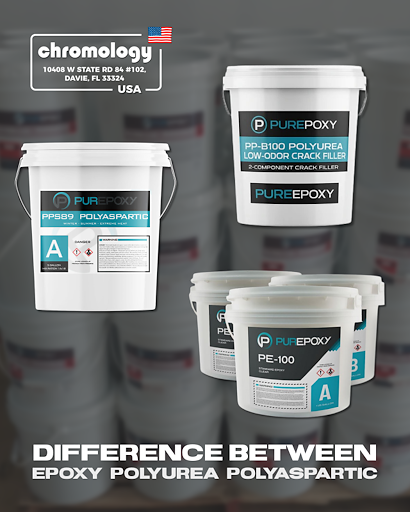

What’s the difference between epoxy, polyurea, and polyaspartic?
Choosing the Right Floor Coating Starts With Performance, Not Trends
Choosing the right floor coating system is not about chasing trends or copying what another contractor used on a different job. It’s about performance, installation timing, site conditions, and long-term durability. Each resin technology has strengths, limitations, and ideal use cases – and understanding those differences is what separates professional installations from costly failures.
At Chromology Florida East Inc., located at 10408 W State Rd 84, Davie, FL 33324, we work daily with contractors, facility managers, and professional installers across South Florida. From residential garages to high-traffic commercial environments, our role is to help you select the right resin system for the job, not just sell you material.
Below is a clear, contractor-focused breakdown of epoxy, polyurea, and polyaspartic floor systems – using real-world performance criteria, not marketing hype.
Epoxy Floor Coatings
Best for: Interior spaces, garages, shops, warehouses, basecoats
Epoxy remains the backbone of the resinous flooring industry and continues to be one of the most widely used systems for concrete floors.
Why contractors use it:
- Exceptional adhesion to properly prepared concrete
- High-build capabilities for smooth, level finishes
- Cost-effective solution for large square footage
Considerations:
- Longer cure times compared to newer technologies
- Not UV stable and can yellow when exposed to sunlight
- Less flexible than polyurea-based systems
When to use epoxy:
Epoxy is ideal for interior applications where durability, thickness, and value matter more than fast return to service or UV resistance. It is often used as a basecoat or build layer within multi-coat systems.